
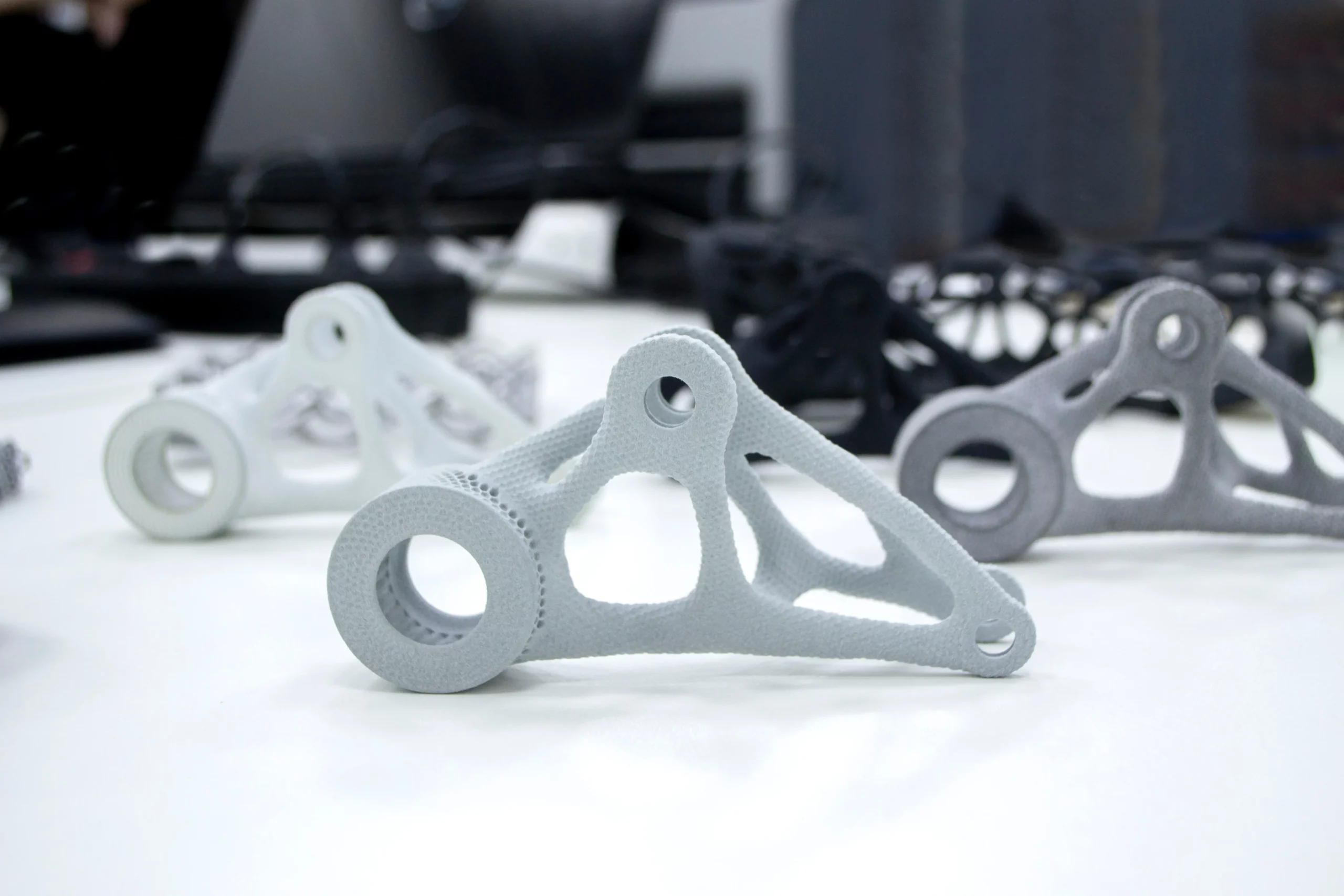
Injection molding and 3D printing are technologies that weren’t compared much until recently. Injection is, after all, production, and 3D printing is only a method for prototyping and possibly printing individual parts, correct?
While this is still true for most 3D printing solutions, large 3D printers intended for use in production have been available on the market for several years now. One such device is, among others, the HP Multi Jet Fusion, a large 3D printer designed for precise printing, also in mass production.
In the following article, we will describe in what situations industrial 3D printing can be an effective and profitable alternative to injection molding.
Injection Molding and Multi Jet Fusion Technology: Basic Differences
When HP released the first Multi Jet Fusion devices to the market in 2016, this type of solution was something completely new. Although 8 years have passed since then, many companies still have no idea about the existence of this technology, and in their eyes, 3D printing remains only a method of creating prototypes.
In the case of injection molding, the situation is completely different. This technology has had the status of the best solution in producing plastic parts for decades, and this does not change, at least when it comes to mass production.
In the case of shorter series, however, competition in the form of MJF is very attractive. It can bring significant benefits and even enable the implementation of projects that could not be created using any other technology.
Here’s a quick summary of the key features of both solutions:
Injection molding | HP Multi Jet Fusion | |
Quality and precision of manufactured parts | Excellent quality and accuracy are considered the highest standard in the industry | Accuracy similar to injection: +/-0.3mm ≤ 100 mm, +/-0.3% >100 mm -, same strength on each axis |
Possibility to change the design between series | Very expensive or impossible | Limitless with no additional costs |
Delivery time of the first parts | Even a few months after ordering the injection mold | From 3 to 5 days |
Initial cost | Even over $100,000 | $0 |
Scalable | Easy and cheap | Fixed price but limited scalability |
Profitability depends on volume | Profitability is usually achieved from several thousand pieces + | From 1 piece to several hundred or even several thousand. |
In the following parts of the text, we will discuss the above issues in more detail.
When is 3D printing profitable?
In short, 3D printing is a profitable solution when investing in an injection mold is inadvisable or too expensive.
This can mainly mean two things:
- The project is still developing, and we have yet to determine its final form, so we cannot invest in an injection mold.
- We don’t need a large enough number of parts to justify investing in an injection mold.
By using 3D printing, we have a lot of freedom in terms of when and how many parts we order. This flexibility gives teams the ability to introduce just-in-time and on-demand production. Orders can be placed at the exact number required and reach the company within a few days.
This is how our service is used, among others, by a Polish manufacturer of specialized equipment, Taxus IT. You can read about the history of our cooperation here.
Design possibilities in MJF technology
Multi Jet Fusion (MJF) technology offers extensive design possibilities, often enabling the implementation of projects that would not be feasible with other technologies.
Here are the key features of the technology in terms of design:
- Creating any geometry – MJF technology allows the production of complex geometries that are impossible or very difficult to achieve in traditional production methods, such as machining. This also applies to parts with a hollow internal structure. This allows for a significant reduction in the weight of the elements without losing strength, e.g., by using a honeycomb structure. Importantly, the level of complexity of the created geometries does NOT affect the printing cost as in the case of molding. Openwork forms or hollow elements are cheaper due to their lower weight because volume affects the cost.
- Uniform strength in all axes – the unique process of sintering polyamide powder makes parts manufactured using MJF technology, which is characterized by the same mechanical strength in the X, Y, and Z axes. This is a significant advantage compared to some other additive technologies, where strength in the Z axis may be a limitation.
- Optimization for functionality and performance – MJF allows for the inclusion of threads, inserts, and other parts, eliminating the need for assembly and simplifying manufacturing processes.
To sum up, MJF enables the creation of durable, light, and advanced structures. Thanks to these features, this technology is used in many industries, from the medical industry through the automotive industry to consumer electronics. Therefore, when comparing the scope of potential applications of the technology, industrial 3D printing is very similar to injection technology.
What types of elements can be created using MJF technology?
Due to the quality of the parts created, the potential scope of MJF technology application is the same as that of injection molding. The only limitation is the scale. As long as the demand for parts is low, Multi Jet Fusion 3D printing will be able to replace injection molding cost-effectively.
When it comes to specific applications, this solution is perfect for creating parts such as:
- device housings – e.g., medical equipment
- precise components of electronic devices – e.g., Cortivision
- format parts – e.g., parts for production for Colgate Palmolive Manufacturing
- tools and machine parts – e.g., car painting support holder
If you are wondering whether Multi Jet Fusion technology will work in your case and will allow you to complete the project quickly and at a much lower cost, write to us.