
Although 2024 did not bring such significant challenges for global supply chains as, for example, the pandemic, there is no shortage of obstacles.
Persistent geopolitical conflicts, natural disasters, and a host of other problems, often entirely new for the industry, stand in the way of a safe and stable supply chain for thousands of companies around the world.
And with new problems, there are also new solutions. Thanks to fast, local production, additive technologies often become the answer.
In this article, we will talk about the new, extremely important role of 3D printing in modern supply chains.
From emergency solution to a default method
Modern, industrial 3D printing, in many cases, appears as a lifeline when the original solutions fail or are no longer available. The biggest challenges of the supply chain in the coming years include:
- Geopolitical conflicts and consequences of embargoes and international agreements
- Crisis in the Red Sea
- Global port congestion
- Natural disasters
- Shortages of key raw materials
Whatever the reason, businesses are forced to look for alternative solutions. In the case of plastic parts, the idea of using 3D printing is becoming more and more popular. However, it usually involves maintaining a certain level of skepticism towards these technologies.
Why are supply chain experts cautious about 3D printing?
Previously, this solution had not been considered at all, primarily due to the continuing reputation of 3D printing as a technology suitable only for creating prototypes. For almost a decade, however, this opinion has no longer had much to do with reality.
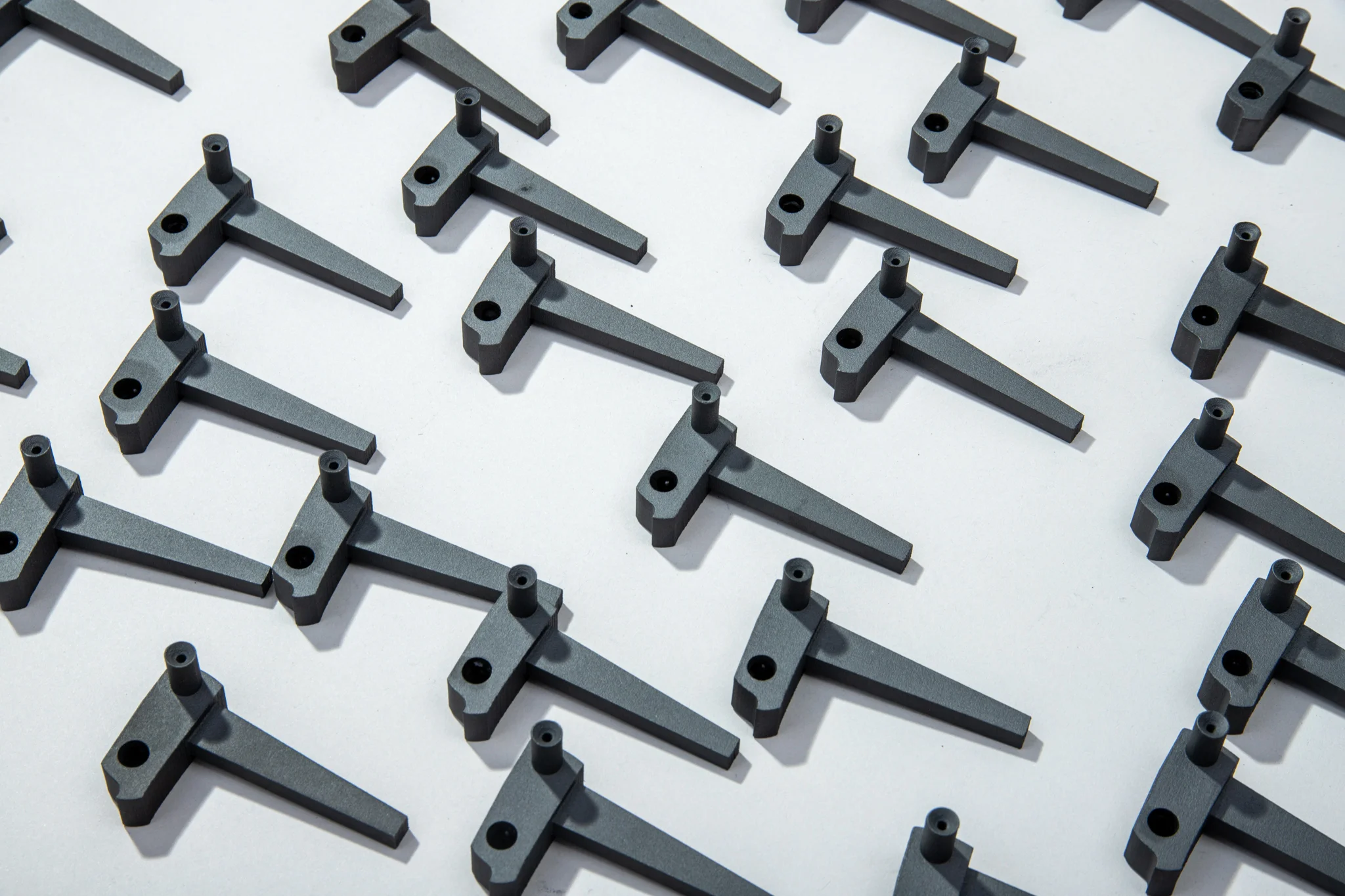
Over the last few years, significantly improved technologies have appeared on the market. They were created for precise series production, not just prototypes. These are much larger devices with production capacities, allowing the creation of up to several hundred parts in one process. This is precisely what HP MJF technology is.
In the end, companies take their chances with modern 3D printing. It quickly turns out that HP Multi Jet Fusion can receive several hundred high-quality plastic parts with precision in just a few days.
3D printing is thus becoming not only the fastest available method of producing spare parts, housings, or tools, but also the most profitable and safest possible.
What makes companies permanently include 3D printing in their supply chain?
Most companies that decide to try 3D printing implement this solution permanently.
This happens for five main reasons.
1. Fast order processing within five business days
- Elimination of long production cycles: MJF technology does not require expensive forms or complicated processes. The most important thing is the design, which may require some optimization.
- Operational agility: The ability to quickly respond to changing demand or customer needs translates into better inventory management and reduced excess inventory.
- Minimizing downtime: In emergencies, such as machinery damage or urgent orders, parts can be produced and delivered quickly.
- Enabling the implementation of just-in-time production: Fast deliveries allow for the implementation of just-in-time output – tailored to precise market demand, which greatly impacts the company’s financial liquidity.
2. Local production independent of global factors
- Reducing the risk of interference: Local production makes the supply chain independent of global factors, such as political conflicts, natural disasters, pandemics, or delays in international transport.
- Reduced carbon footprint: Locating production closer to consumers reduces transport-related CO₂ emissions, supporting sustainable development.
- Resistance to lack of raw materials: The powder produces parts from commonly available materials.
3. High-quality of manufactured parts similar to injection technology
- Repeatability: MJF provides accuracy of +/- 0.3 mm ≤ 100 mm, +/- 0.3% >100 mm – very similar to injection technology.
- Solid mechanical properties: Printed parts have the same high strength on every axis, and a specific production method based on sintering powder allows you to create solid, low-weight parts.
4. Possibility of changing the design between series
- No need for costly retooling: In traditional production methods such as injection molding, changing the design requires costly and time-consuming modification of the molds. Sometimes, it is impossible. In MJF, it is enough to change the design itself.
- Increasing innovation and easy adaptation to customer needs: Rapid design iteration enables companies to quickly improve and adapt products to changing market demands.
5. Ability to work with functional prototypes
- Testing in real conditions: Prototypes made using MJF technology are durable enough to be tested in the same conditions as finished products.
- Reduced product development time: The manufacturer can simultaneously create, test, and improve functional parts before deciding on possible mass production.
- Savings on research and development: Instead of investing in costly injection molds early in the project, the company can thoroughly verify and optimize the product design before mass production begins.
How to start implementing 3D printing?
As we mentioned at the beginning of the article, the most challenging step in implementing technology into the supply chain is the first step. This is often hampered by complex supplier approval processes and aversion to new technologies.
That’s why crises often push companies in this direction, no matter how great the benefits may be.
However, the benefits of this solution are quickly changing the perception of this technology. If you want to know what 3D printing can do for your company, make an appointment for a consultation.