
Additive manufacturing is becoming one of the most critical technologies that support innovation and optimization in the defense industry.
By using modern 3D printing technologies, such as HP Multi Jet Fusion, they benefit from quick access to light, durable, and precisely made plastic parts.
Moreover, they can be produced locally without the involvement of foreign suppliers and exposure to the risks of the modern supply chain.
This is how 3D printing is revolutionizing modern reinforcements.
What benefits do additive technologies provide to the military industry?
Additive manufacturing covers a wide range of technologies, including extremely common, small FDM (Fused Deposition-Modeling) desktop printers and very large devices that can even create large structures and buildings. However, from the military industry’s point of view, these are not very important—perhaps with the exception of the initial prototyping stage.
On the other hand, we have industrial 3D printing, which is of revolutionary importance for the development and production of military equipment. The best example of such tech is Multi Jet Fusion, created by HP
These large production devices enable the production of large numbers of plastic parts in a very fast process. Moreover, they can print parts with almost any geometry, significantly expanding design possibilities.
This means that they meet several key requirements of the military industry, such as:
- Fast order fulfillment.
- High-quality components.
- High repeatability.
- Production of a large number of parts in the on-demand model – following precise requirements.
- Local production that isn’t exposed to global supply chain complications.
- Possibility to create much lighter, more optimized elements.
In the next section, we will discuss the above-mentioned advantages in a little more detail.
3D printing as a technology that fits into the army’s long-term strategies
Fast order fulfillment and rapid adaptation of solutions to changing needs and conditions
To produce parts using MJF technology, only a 3D design is required. Unlike injection molding, the order fulfillment time is reduced from several months to 3-5 business days. Importantly, the ordered designs can be freely modified between series.
This significantly improves the technological development of the army and increases its adaptability. Traditional manufacturing methods, such as casting and machining, often require long lead times, especially when custom or hard-to-find parts need to be produced.
In the case of 3D printing, such limitations and complications do not exist. Thanks to this, the army can quickly replenish missing equipment elements, modernize equipment, and implement innovative solutions without long-term waiting for deliveries from traditional production lines.
High quality and repeatability of created parts
In terms of precision and durability of the parts created, Multi Jet Fusion technology is much closer to injection molding than to the commonly known 3D printing using FDM technology. Unlike older technologies, MJF provides the same strength on each axis and an accuracy of ±0.3 mm ≤ 100 mm ±0.3% > 100 mm.
Moreover, the parts can be used in many applications. For example, they can have IP66 or IP67 certification for resistance to dust and water immersion.
Meeting quality standards enables the use of MJF in the production of not only prototypes but also full-value utility parts for combat equipment, drones, protective systems, and individual equipment for soldiers. This allows the Army to benefit from modern, tailored solutions that are on par with standard industrial methods while providing greater flexibility and speed of production.
Implementation of the just-in-time model
One of the key advantages of 3D printing technology, including HP Multi Jet Fusion (MJF), is the complete elimination of the MOQ (Minimum Order Quantity) problem, i.e., the minimum order quantity required in traditional production. In the case of injection, starting production costs up to several hundred thousand dollars and, above all, a very long lead time, which means that profitability depends on large series.
With MJF, each part can be produced on demand, regardless of quantity. This provides complete flexibility in implementing non-standard, custom solutions tailored to the specific needs of the military.
This means implementing effective just-in-time production—exactly when a given part is needed. It also means significant improvement in military logistics, elimination of storage costs, and the ability to respond dynamically to changing needs. Thanks to this, the army gains not only modern technologies but also maximum operational freedom in resource management.
Local production
Local production is a trend that has much to offer the military industry. It shortens the implementation time and strengthens the operational independence of the armed forces. By producing parts within the country’s borders, we reduce the risks associated with global production and transport, such as conflicts, sanctions, logistics crises,, or a lack of raw materials.
A secure supply chain, resistant to changing market conditions
A stable supply chain is an invaluable asset for military entities, and the results of the pandemic and global conflicts have highlighted the potential threats associated with it.
In the American publication from Army University Press regarding the impact of the supply chain on the state of the army, we read about rising prices and lack of availability of raw materials or urgent problems related to logistics. Attention was also drawn to the risks associated with relying on foreign suppliers.
Short lead times are particularly important in combat conditions or overseas missions, where access to factories and supplies may be limited. The ability to print parts on-site or near the operational zone significantly increases the self-sufficiency of military units by eliminating the need to transport heavy supplies and reducing the risk of logistical delays.
Rapid production and implementation of new technologies thanks to 3D printing gives the army a strategic advantage, enabling a dynamic response to the changing needs of the battlefield and continuous improvement of soldiers’ equipment.
Reduction of equipment weight
Technology has always been key in reducing the burden on military equipment and soldiers’ luggage, enabling the production of lighter but equally durable equipment.
Modern 3D printing, especially HP Multi Jet Fusion (MJF) technology, has the potential to become a breakthrough solution in this field. Thanks to the precise application and sintering of polymer powders, it allows the creation of light, durable, and geometrically complex components that would be difficult or impossible to produce using traditional methods.
This technology allows for structural optimization of parts (e.g. by using internal trusses), which further reduces their weight while maintaining the required resistance to mechanical loads and extreme conditions.
Thanks to MJF, it is also possible to quickly prototype and adapt equipment to soldiers’ individual needs, increasing their mobility and comfort without compromising safety. Thus, modern 3D printing significantly reduces total military baggage, facilitating the transport, logistics, and operational efficiency of the armed forces.
Examples of equipment created with the support of 3D printing
Industrial 3D printing in the military industry will most often be used to produce:
- Housings for devices and parts (drones, measuring devices, equipment elements, etc.).
- Spare parts (especially for older devices where the manufacturer has ceased production).
- Prosthesis.
- Elements of vehicles and cockpits.
- Tools used in production.
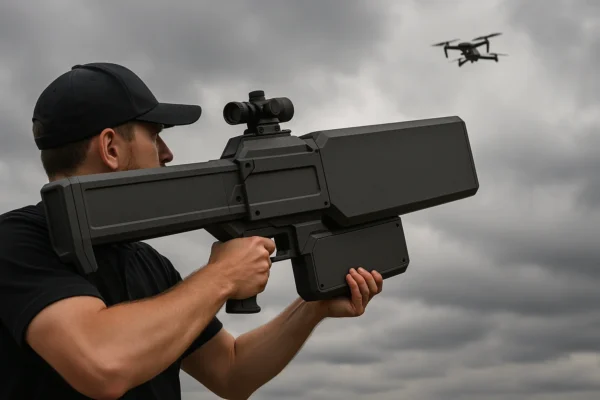
In the history of our company, we have had the opportunity, among others, to: provide parts for drone neutralization devices, precision measurement tools, and even devices for examining brain activity that were used in space.
These projects are excellent confirmation of the potential of 3D printing for the military industry.
If you feel that this solution will work in your case, please contact our 3D printing specialist.