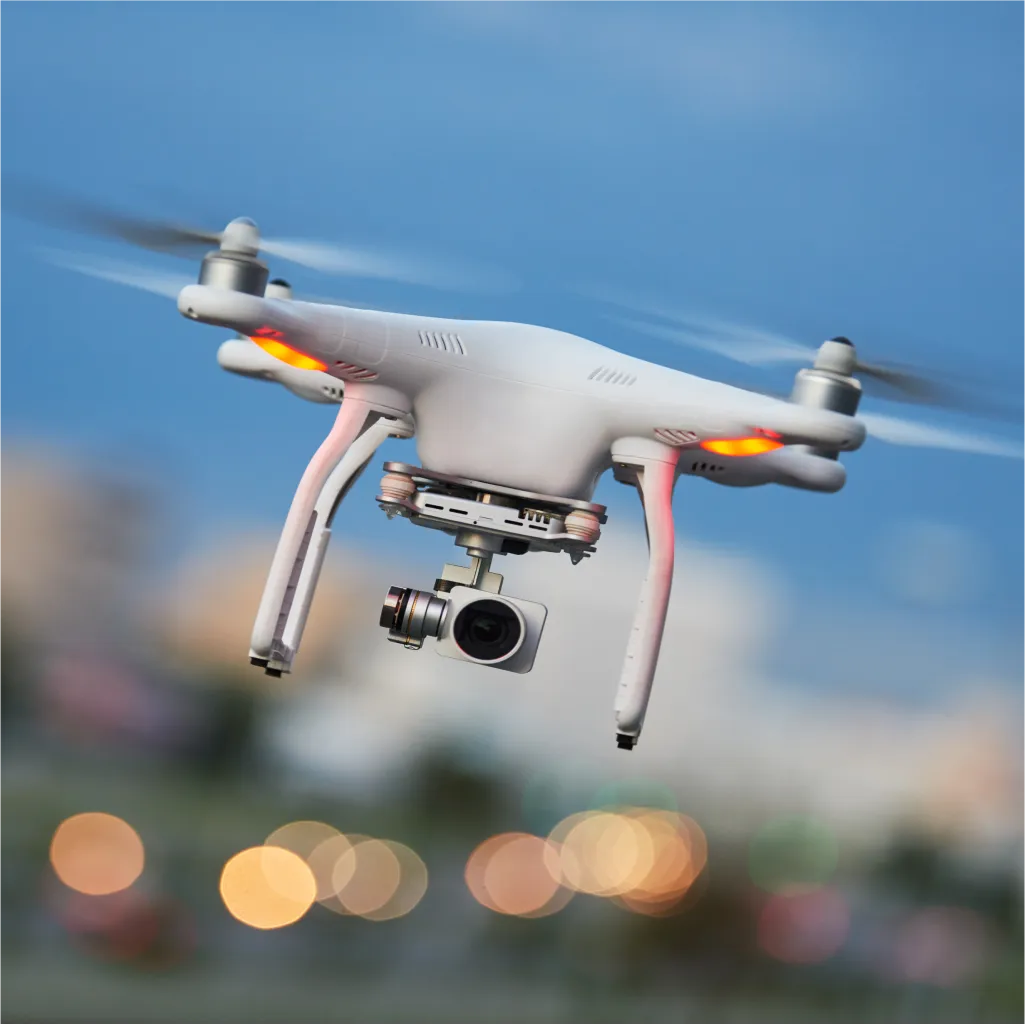
If we look at the main advantages of HP MJF industrial 3D printing and then at the key needs of modern production (e.g. drones), the dots practically connect themselves.
Rapid prototyping, on-demand mass production, significantly greater freedom in device design and several other unique advantages make modern 3D printing a key technology in innovative production.
Drone production is no exception. In recent years, thousands of drone parts have been created on our machines, and this number will only increase.
In this article, we will describe exactly what makes Multi Jet Fusion technology so perfectly suited to the needs of drone companies.
What is MJF, and how is it revolutionizing drone production?
HP Multi Jet Fusion is a production-grade solution that takes 3D printing to a whole new level of business maturity. It delivers predictable surface quality, high-dimensional consistency, and mechanical parameters that allow parts to be deployed directly into operational applications.
In practice, this means fewer reworks, fewer rejects, and a shorter time from design to finished item.
Importantly, MJF doesn’t stop at prototypes. The technology supports the full spectrum of needs: from rapid functional testing, short runs and custom variants, to stable, on-demand mass production.
For manufacturing companies, this means real supply chain flexibility, the ability to consolidate suppliers and reduce inventory, and therefore tangible savings and faster market decisions.
As a result, 3D printing is no longer an “R&D tool” but rather a component of the production infrastructure: scalable, repeatable, and ready to work in the rhythm of iterative product development. In the following sections, we will demonstrate how these advantages translate into individual stages of the process—from design and prototyping, through short runs, to mass production and after-sales support.
1. Design and initial prototyping stage
For mission-critical drones—from inspection and agricultural to rescue and military—product development time is crucial. MJF technology significantly shortens and improves this timeframe, with the ability to work with functional prototypes playing a significant role.
Key benefits:
- Rapid concept and geometry validation.
- Precise matching of components such as motors, sensors and camera modules.
- Real-world ergonomics and aerodynamics testing thanks to fully functional prototypes.
- Skip the initial stages and move immediately to flight-test-ready prototypes.
You can read more about the use of functional prototypes in our article:
Functional prototypes in the device creation process
And since we’re on the subject of product development, it’s impossible to talk about the potential of MJF without mentioning the DfAM (Design for Additive Manufacturing) approach.
The importance of the DfAM (Design for Additive Manufacturing) concept in drone production
DfAM is a design approach in which engineers do not adapt designs to the limitations of traditional methods, but create elements that are optimised for 3D printing.
The three foundations of DfAM are:
- Parts consolidation– combining multiple elements into one component, which reduces assembly costs and reduces the risk of failure.
- Topological optimization– use of algorithms that reduce the mass of the structure while maintaining its strength.
- Complex geometries– grid fillings, organic forms or internal cooling channels that cannot be made using traditional methods.
Only by designing in line with DfAM do companies fully exploit the potential of MJF – and drones become lighter, more durable and optimized for specific missions.
The DfAM concept is described in more detail in the article:
How is DfAM (Design for Additive Manufacturing) revolutionizing processes in modern companies?
2. Pre-series and short-series production stage
At this stage, companies need to test their solutions in real-world conditions, present them to customers, and at the same time avoid the high costs of launching full production. MJF 3D printing perfectly meets these needs – it allows for the rapid production of small batches of components with the quality of a final product.
Key benefits:
- Production of limited series in a short time.
- Possibility to make design changes after testing.
- Iterative development – the “print → test → improve” cycle is becoming the standard.
- Faster time to market.
- On-demand production improves financial liquidity.
- Personalization of drone models for specific tasks and clients.
This is a stage where companies traditionally invested in expensive tools or maintained inventories. Thanks to MJF, this barrier disappears – production is flexible, and the financial risk is significantly reduced.
3. Serial production stage
As a drone project moves to the market, ensuring stable, scalable, and repeatable production becomes crucial. And this is where the HP Multi Jet Fusion demonstrates its greatest advantage. It removes the boundary between prototyping and serial production. The same technology that allowed for rapid iteration and testing is becoming a tool for the reliable production of final components.
The most important values at this stage:
- Dynamic scalability– the ability to quickly move from small batches to larger series without changing technology.
- Market flexibility– production of many variants of drones in parallel, also in short cycles, which allows for a quick response to customer needs.
- On-demand manufacturing– reducing inventory and storage costs by producing exactly when demand occurs.
- Customization on a scale– serial delivery of models tailored to specific missions or users, without compromising quality.
There is also more and more talk about a new trend: mobile production. Containers equipped with industrial 3D printers (e.g. design Launch Firestorm) are becoming more and more prevalent. Thanks to them, parts can be manufactured close to the point of use – at military bases, logistics centers, or during rescue operations – which further increases the flexibility of the supply chain.
In practice, MJF allows you to treat 3D printing not as R&D support, but as fully-fledged production technology– ensuring speed of response, cost-effectiveness and unlimited product configuration possibilities.
At this stage, 3D printing is best suited for production of small elements.
4. Maintenance and after-sales support stage
Simply delivering the right parts isn’t the only value of 3D printing, of course. By producing additively, in a more agile, flexible model, parts can be delivered on demand, in emergencies, and with any design changes made to each subsequent order.
Value HP Multi Jet Fusion is invaluable here.
Production of spare parts and additional components on demand. It also means the end of long downtimes, high storage costs or problems with the availability of components.
Key business benefits:
- Minimizing downtime– parts can be manufactured exactly when they are needed, reducing service time and keeping the fleet operational.
- Lower logistics and warehousing costs– no need to maintain stocks of rarely used items.
- Flexible individualization– from dedicated handles and covers to personalized markings and labels for operators.
- Extended product life cycle– quick availability of spare parts means that drones can operate longer, which directly increases the return on investment for the customer.
Thanks to this, drone manufacturers can offer more than just a device but a comprehensive value throughout the product life cycle– from the first flight to many years of operation.
It is this aspect that often determines competitive advantage in an industry where reliability and availability of equipment are absolutely crucial.
HP Multi Jet Fusion as a key technology in modern drone production
HP Multi Jet Fusion technology redefines the way mission drones are built. From rapid prototyping and DfAM design, through short-run and serial production, to after-sales support.
MJF delivers speed, flexibility, and quality that traditional methods don’t offer. For manufacturers, this translates into faster time-to-market, greater process cost-effectiveness, and the ability to build competitive advantage through personalization.
For users – greater reliability, parts availability and solutions precisely tailored to their needs.
We encourage manufacturers of drones and similar devices to familiarize themselves with the technology.